

 日本語
日本語 한국어
한국어 Français
 Deutsch
 Español
 Italiano
 Português
 Việt Nam
 Türkçe
 عربي
عربي  русский
  简体中文
简体中文 Čeština
 ไทย
ไทย Eesti
Eesti Gaeilgenah Éireann
 Bai Miaowen
 íslenska
 Cymraeg
 Български
 اردو
اردو Polski
 hrvatski
 українська
 bosanski
 فارسی
فارسی Lietuvių
 Latviešu
 עברית
עברית România limbi
 Ελληνικά
 dansk
dansk magyar
 Norsk
Norsk suomi
suomi Nederlands
 Svenska
 slovenčina
 slovenščina
 हिंदी
हिंदी Indonesia
 Melayu
 Malti
Malti Kreyòl Ayisyen
 Català
 বাংলা
বাংলা Srbija jezik (latinica)
 O'zbek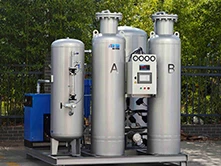


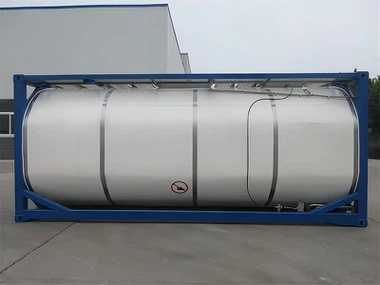

What Is An Air Separation Unit (ASU)?
May 26, 2025
Leave a message
Air separation units (ASUs) are critical industrial systems designed to separate atmospheric air into its primary components-oxygen, nitrogen, and argon-using various physical and chemical processes. These units play a pivotal role in industries ranging from metallurgy and healthcare to energy and environmental technologies. This article provides a technical overview of ASUs, their operational principles, key types, and real-world applications, with a focus on optimizing search engine visibility for industry-specific queries.

Core Principles of Air Separation
Atmospheric air is a mixture of 78% nitrogen, 21% oxygen, 0.93% argon, and trace gases. Air Separation Unit leverage differences in boiling points, molecular sizes, or adsorption capacities to isolate these components. The three primary separation methods include:
Cryogenic Distillation
Mechanism:
Utilizes extreme cooling to liquefy air (-196°C for nitrogen, -183°C for oxygen).
Liquefied air is separated in distillation columns based on boiling point differences: nitrogen (lower boiling point) vaporizes first, leaving oxygen and argon.
Applications:
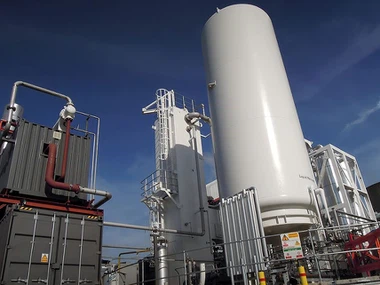
Large-scale production (100–100,000 Nm³/h) for steelmaking, chemical synthesis, and cryogenic storage.
Advantages: High purity (99.5%+ oxygen/nitrogen), suitability for bulk gas production.
Challenges: High energy consumption, complex infrastructure, and long startup times (12–24 hours).
Pressure Swing Adsorption (PSA)
Mechanism:
Uses zeolite molecular sieves to adsorb nitrogen from air at high pressure, releasing oxygen.
A cyclic process (adsorption/desorption) operates at ambient temperature, with rapid switching (minutes per cycle).
Applications:
Medium-scale production (5–500 Nm³/h) for medical oxygen, wastewater treatment, and food packaging.
Advantages: Low energy use, compact design, and quick startup (minutes).
Challenges: Lower purity (90–95% oxygen) compared to cryogenic methods.
Membrane Separation
Mechanism:
Relies on semi-permeable membranes to filter gases based on molecular size: oxygen (smaller molecules) permeates faster than nitrogen.
Applications:
Small-scale, decentralized systems (1–50 Nm³/h) for laboratory use, onboard vehicle oxygen, and remote industrial sites.
Advantages: Simple operation, minimal maintenance, and no moving parts.
Challenges: Lowest purity (up to 90%) and limited throughput.
Key Components of Air Separation Units
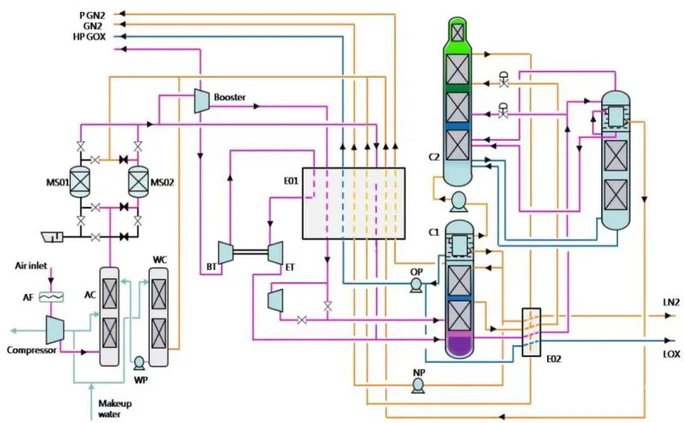
Air Compression and Preprocessing
Air Filter: Removes particulates (dust, oil) to prevent contamination.
Compressor: Increases air pressure to 3–10 bar (cryogenic/PSA) or 1–2 bar (membrane).
Cooling and Drying: Refrigeration dryers or moisture adsorbers remove water vapor to prevent ice formation in cryogenic systems or membrane fouling.
Separation Modules
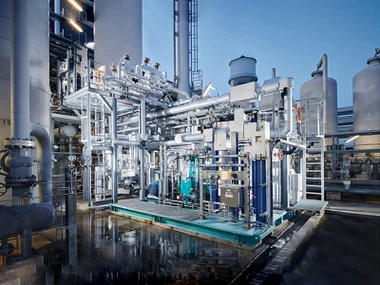
Cryogenic Columns: Multi-stage distillation columns (high/low pressure) for fractional separation.
PSA Vessels: Stainless steel tanks filled with adsorbents (zeolite, carbon molecular sieves).
Membrane Modules: Hollow-fiber or spiral-wound membranes with selective permeability.
Product Recovery and Purification
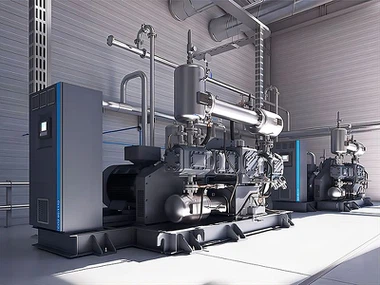
Oxygen/Nitrogen Compressors: Boost pressure for storage or pipeline transport.
Purification Systems: Catalytic converters (for trace hydrocarbons) or adsorption beds (for CO₂ in medical oxygen).
Industrial Applications of ASUs
Metallurgy and Manufacturing
Oxygen: Used in blast furnaces for steelmaking (increases furnace efficiency by 20–30%) and welding/cutting.
Nitrogen: Inert gas for heat treatment, metal degassing, and preventing oxidation during casting.
Case Study: A 40,000 Nm³/h cryogenic ASU in a Peruvian steel plant (operated by NEWTEK ) ensures continuous oxygen supply for high-volume production.
Healthcare and Life Sciences
Medical Oxygen: PSA systems produce 93–95% pure oxygen for hospitals, meeting ISO 13485 standards.
Example: NEWTEK's 51000 Nm³/h ASU in a Philippine hospital provides reliable oxygen for critical care units, aligning with WHO guidelines for medical gas purity.
Energy and Environmental Technologies
Oxygen for Carbon Capture (CCUS): High-purity oxygen (95%+) supports oxy-fuel combustion in power plants, enhancing CO₂ capture efficiency.
Nitrogen for Oil & Gas: Inert gas for pipeline purging, well stimulation, and enhanced oil recovery (EOR).
Renewables: Membrane ASUs supply oxygen for biogas upgrading and nitrogen for wind turbine component preservation.
Chemical and Food Industries
Oxygen: Oxidation reactions in ammonia/ethylene production.
Nitrogen: Modified atmosphere packaging (MAP) for food preservation, preventing microbial growth.
Comparison of ASU Technologies
| Parameter | Cryogenic Distillation | PSA | Membrane Separation |
|---|---|---|---|
| Throughput | 100–100,000 Nm³/h | 5–500 Nm³/h | 1–50 Nm³/h |
| Oxygen Purity | 99.5–99.99% | 90–95% | 30–90% |
| Energy Consumption | High (1.5–3 kWh/Nm³ O₂) | Medium (0.4–1 kWh/Nm³ O₂) | Low (0.1–0.5 kWh/Nm³ O₂) |
| Startup Time | 12–24 hours | 5–15 minutes | Instant |
| Capital Cost | Very high | High | Low |
| Ideal Use Case | Bulk gas production | On-demand, medium-scale | Decentralized, low-purity |
NEWTEK :
As a world-class gas systems provider, NEWTEK has established itself as a pioneer in advanced air separation technologies. With over 9,000 systems installed globally, the company specializes in delivering tailored ASU solutions across cryogenic, PSA, and membrane technologies.
Key Capabilities:
Cryogenic Expertise:
Design and deployment of large-scale cryogenic ASUs (up to 100,000 Nm³/h) for industrial gas giants and steel manufacturers. Notable projects include a 4x40,000 Nm³/h air separation project in Peru, optimizing oxygen supply for metallurgical processes.
PSA Innovation:
Medical-grade PSA oxygen plants (compliant with ISO 13485 and ASME standards) used in government hospitals across the Philippines and Ghana. These systems ensure reliable, high-purity oxygen (93–95%) for healthcare facilities, even in remote areas.
Sustainability Focus:
Integration of CCUS technologies into ASU designs, supporting industrial decarbonization. For example, NEWTEK's gas systems enable efficient CO₂ capture in power plants, aligning with global net-zero goals.
Partnerships:
Strategic collaborations with Hangzhou Oxygen Plant (China) and international energy firms, ensuring end-to-end solutions from system design to maintenance.
Technical Excellence:
R&D Capability: Continuous investment in molecular sieve technology and energy-efficient cryogenic cycles, reducing operational costs by 15–20% for clients.
Compliance: All systems meet regional standards (e.g., EPA, CE, ASME BPVC), with certifications for medical and industrial applications.
Customer Impact:
Healthcare: Donated oxygen generators to Australian and Southeast Asian communities, improving access to life-saving medical gas.
Industrial Efficiency: A 30,000 Nm³/h ASU in Ghana reduced a chemical plant's reliance on bottled gases, cutting logistics costs by 40%.
Conclusion
Air separation units are indispensable to modern industry, enabling efficient production of critical gases while supporting sustainability goals. Whether through cryogenic precision for steelmaking, PSA flexibility for healthcare, or membrane simplicity for remote sites, ASUs drive operational excellence across sectors.
NEWTEK 's global footprint and technical innovation position it as a leader in delivering reliable, high-performance ASU solutions. With a focus on energy efficiency, compliance, and customer collaboration, the company continues to shape the future of gas separation technology, empowering industries to operate cleaner, safer, and more efficiently.
For technical specifications or project inquiries, visit NEWTEK 's official website: https://www.newtek-group.com to explore their comprehensive range of air separation systems and advanced gas solutions.