

 日本語
日本語 한국어
한국어 Français
 Deutsch
 Español
 Italiano
 Português
 Việt Nam
 Türkçe
 عربي
عربي  русский
  简体中文
简体中文 Čeština
 ไทย
ไทย Eesti
Eesti Gaeilgenah Éireann
 Bai Miaowen
 íslenska
 Cymraeg
 Български
 اردو
اردو Polski
 hrvatski
 українська
 bosanski
 فارسی
فارسی Lietuvių
 Latviešu
 עברית
עברית România limbi
 Ελληνικά
 dansk
dansk magyar
 Norsk
Norsk suomi
suomi Nederlands
 Svenska
 slovenčina
 slovenščina
 हिंदी
हिंदी Indonesia
 Melayu
 Malti
Malti Kreyòl Ayisyen
 Català
 বাংলা
বাংলা Srbija jezik (latinica)
 O'zbek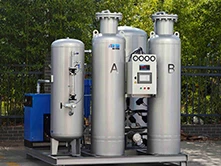


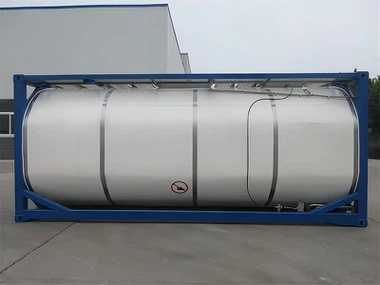

A Review Of Air Separation Technology And Its Integration With Energy Conversion Processes
May 26, 2025
Leave a message
Air separation technology is the core of industrial gas production, and its integrated optimization with energy conversion processes is crucial to improving industrial efficiency and reducing costs. This paper systematically reviews the principles, economics and application scenarios of traditional and emerging air separation technologies (cryogenic distillation, adsorption, membrane separation, ion transport membrane, etc.), focusing on the integration of cryogenic and non-cryogenic technologies in gas turbines, coal gasification combined cycle (IGCC) and syngas production. Through technical comparison and case analysis, the development trend and future research direction of air separation technology in the energy field are revealed.

Introduction
Industrial gases (oxygen, nitrogen, argon) play a key role in the energy conversion process, and the selection and integration of their production technology directly affect the economy and efficiency of the facility. This article discusses the following core issues:
Applicable scenarios of different air separation technologies (purity, scale, energy consumption)
Integration strategy of air separation unit (ASU) and downstream processes (such as gasification, combustion, power generation)
Challenges and supplements of emerging technologies (such as ion transport membranes) to traditional cryogenic processes
Non-cryogenic air separation technology
Adsorption method (PSA/VSA)
Principle: Utilize the selective adsorption of nitrogen by zeolite or carbon molecular sieve to achieve oxygen and nitrogen separation through pressure swing cycle.
Process: Compressed air enters the adsorption tower, nitrogen is adsorbed, and oxygen-rich gas (93-95% purity) is discharged as a product; the saturated tower is regenerated by pressure reduction (Figure 1).
Advantages: Fast startup (minutes), modular design suitable for small and medium scale (<150 tons/day).
Limitations: Argon cannot be produced, and the byproduct nitrogen has a high oxygen content and requires additional purification.
Chemical absorption method
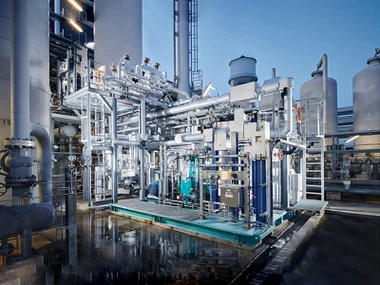
Case: MOLTOXe molten salt process (Figure 2)
Process: Compressed air reacts with molten salt after pretreatment, oxygen is absorbed and desorbed by heating/depressurization.
Advantages: Low power consumption for air compression, and waste heat from the process can be used.
Challenges: Significant high-temperature corrosion problems, not yet commercialized.
Polymer membrane separation
Mechanism: Based on the smaller kinetic diameter of oxygen molecules, selective permeation through membrane materials (Figure 3).
Features: No moving parts, suitable for low-purity scenarios (25-50% oxygen-enriched air), the scale is usually <20 tons/day.
Application: Aquaculture oxygenation, coal mine inerting.
Ion transport membrane (ITM)
Technological breakthrough: High-temperature ceramic membranes achieve separation through oxygen ion conduction (Figure 4), with a purity of more than 99%.
Integration potential: When combined with gas turbines, high-pressure nitrogen byproducts can be directly used for power generation, with a thermal efficiency increase of 15-20%.
Current status: In the pilot stage, material durability needs to be optimized.
Cryogenic distillation technology: current status and evolution
Process core
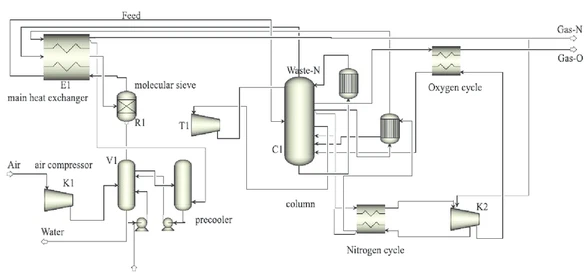
Principle: Utilize the difference in boiling points of air components (O₂ -183℃, N₂ -196℃) to achieve separation through a two-stage distillation tower (Figure 5).
Key steps:
Compression and pretreatment: Air is compressed to 6-10 bar, and molecular sieves remove CO₂ and water vapor.
Cryogenic separation: Liquefied air is separated into oxygen (tower bottom) and nitrogen (tower top) in the distillation tower, and argon is recovered through the side line.
Energy recovery: The expander uses pressure drop for refrigeration, and the high-efficiency plate-fin heat exchanger recovers cold.
Large-scale and integrated innovation
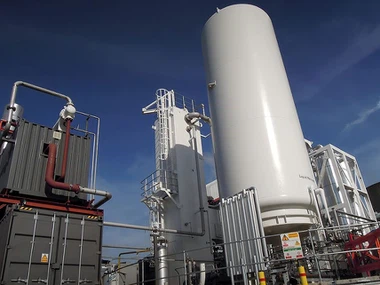
Single set scale: From 500 tons/day in the to the current 5,000 tons/day (Figure 6), the unit investment cost has been reduced by 40%.
Typical integration cases:
Demkolec IGCC power plant (Netherlands): ASU is fully integrated with gas turbine, air is taken from turbine compressor, nitrogen is injected back into combustion end, NOx emission is reduced by 30%, and net power generation efficiency is increased to 47%.
Rozenburg coal gasification project: independent ASU supplies oxygen, nitrogen is used as inert gas for process safety, and syngas production capacity is maximized.
Process optimization
Low pressure (LP) vs high pressure (EP) cycle:
LP cycle: air pressure 65-100 psia, suitable for nitrogen venting scenarios.
EP cycle: pressure > 100 psia, nitrogen can be directly used for process compression, reducing additional power consumption.
Pumping liquid cycle: liquid products are pumped to high pressure to avoid gas compression energy consumption, suitable for scenarios requiring high pressure oxygen (such as coal chemical industry).
Technology comparison and selection guide
Technology Maturity Economic scale (tons/day) Purity (vol.%) Start-up time By-product capacity
Cryogenic distillation Mature >20 ≥99 hours Nitrogen and argon efficient recovery
PSA adsorption Semi-mature <150 93-95 minutes Nitrogen needs to be purified
Membrane separation Semi-mature <20 ≤40 Immediate No
ITM Under development Undetermined ≥99 hours Nitrogen needs to be treated
Selection logic:
Large-scale high-purity demand (such as steel, chemical industry): Prioritize cryogenic distillation, taking into account the value of by-products.
Small and medium-scale flexible scenarios (medical, remote areas): PSA or membrane separation, focusing on rapid deployment and low maintenance.
Future high value-added scenarios: ITM combined with renewable energy, suitable for distributed oxygen production and carbon capture.
Integrated technology: the key to improving energy efficiency
Thermal integration with gas turbines
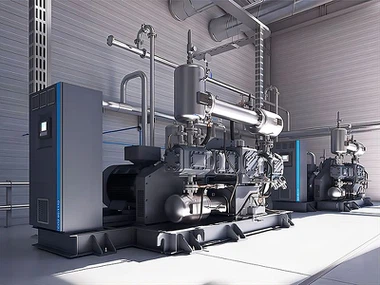
Air extraction: extract part of the air from the gas turbine compressor to the ASU to reduce the power consumption of the independent air compressor (Figure 7).
Nitrogen reinjection: high-pressure nitrogen is injected into the combustion chamber to reduce the flame temperature (NOx↓50%), and at the same time act as a diluent to improve fuel utilization (power generation↑10-15%).
and coal gasification combined cycle (IGCC)
Case: The Tampa Electric project uses high-pressure ASU, the air pressure matches the gas turbine, and nitrogen is used for synthesis gas cooling, and the overall thermal efficiency of the system is increased to 52%.
Advantages: shared compression equipment, waste heat recovery network, and capital costs are reduced by 15-20%
Chemical process integration
Synthesis gas production: ASU oxygen is used for partial oxidation reaction, and the by-product nitrogen is used as a raw material for synthetic ammonia, realizing the "gas-chemical-fertilizer" co-production.
Carbon capture: High-concentration CO₂ produced by oxygen-enriched combustion can be directly sealed to help industrial decarbonization.
Emerging trends and challenges
Technological innovation direction
Material breakthrough:
High-performance adsorbents (such as MOFs) improve PSA selectivity, with a purity of more than 97%.
Composite ceramic membranes solve the problem of high-temperature sealing of ITMs, with a target lifespan extended to 50,000 hours.
Digital transformation: AI algorithms optimize ASU operating parameters, and predictive maintenance reduces downtime by 30%.
Sustainable development needs
Low-carbon process: Use wind power/photovoltaic-driven electrosorption (E-PSA) to achieve a "green electricity-green oxygen" closed loop.
Waste heat utilization: Use chemical waste heat for TSA regeneration, reducing overall energy consumption by 10-12%.

Challenges
Scale bottleneck of non-cryogenic technology: PSA and membrane separation still cannot replace cryogenic distillation in high-purity and high-flow scenarios.
Engineering barriers of ITM: large-scale manufacturing process is immature, and the cost is more than 40% higher than that of low-temperature process.
Conclusion
The development of air separation technology presents a pattern of "low temperature dominates large-scale, non-low temperature fills the niche scenarios", and deep integration with energy conversion process is the core of future competition. Cryogenic distillation continues to optimize efficiency through large-scale and heat integration, while non-cryogenic technology shows potential in flexibility and low carbonization. With the advancement of materials science and digital technology, new models driven by hybrid processes (such as cryogenic + ITM) and renewable energy will reshape the industry landscape and provide key support for carbon neutrality goals.