

 日本語
 한국어
 Français
 Deutsch
 Español
 Italiano
 Português
 Việt Nam
 Türkçe
 عربي
 русский
 简体中文
 Čeština
 ไทย
 Eesti
 Gaeilgenah Éireann
 Bai Miaowen
 íslenska
 Cymraeg
 Български
 اردو
 Polski
 hrvatski
 українська
 bosanski
 فارسی
 Lietuvių
 Latviešu
 עברית
 România limbi
 Ελληνικά
 dansk
 magyar
 Norsk
 suomi
 Nederlands
 Svenska
 slovenčina
 slovenščina
 हिंदी
 Indonesia
 Melayu
 Malti
 Kreyòl Ayisyen
 Català
 বাংলা
 Srbija jezik (latinica)
 O'zbek



Common Fault Problems And Countermeasures Of Gas Compressors
Dec 30, 2024
Leave a message
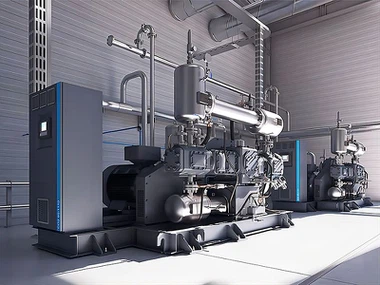
In oil and gas gathering and transportation operations, gas compressors are key equipment, and their stable operation plays a vital role in the smooth progress of the entire operation process. The internal structure of the compressor is complex and there are many parts. Any problem with any part may cause a failure, which in turn has an adverse effect on oil and gas gathering and transportation operations.

I. Operation Mechanism of Gas Compressors
The gas compressor is driven by an electric motor, which drives the connecting rod to make the piston reciprocate to achieve the cycle of suction, compression and exhaust. During suction, the piston moves to the left, the pressure in the cylinder decreases, and the intake valve opens to intake air; during the compression stage, the piston moves to the right and the gas is pressurized; during exhaust, the piston continues to move to the right, the exhaust valve opens to exhaust under the pressure difference, and then the piston moves to the left to inhale, and so on. However, many mechanical parts work together, and once a part fails, it may affect the overall operation.
II. Fault Characteristics
Faults are diverse and difficult to diagnose
The compressor is sophisticated and complex, with many parts and complex structures. Faults are diverse. Multiple faults may coexist in the same part, and faults of different parts are interrelated. For example, a valve failure not only affects the opening and closing of the valve itself, but also causes the temperature to rise, affecting other components, increasing the difficulty of fault diagnosis and analysis, requiring maintenance personnel to have deep professional knowledge and accurately determine the root cause of the fault.

Continuous operation leads to frequent and complex faults
The compressor in oil and gas gathering and transportation runs continuously, with a large workload, many vulnerable parts, and multiple internal systems working together, and multiple faults often occur simultaneously.

III. Common fault problems
Thermal failure
Thermal performance failure occurs during operation. When the exhaust volume does not meet the standard, the exhaust temperature and pressure are abnormal, the equipment efficiency is reduced, and the probability of failure increases greatly. Insufficient exhaust pressure is often caused by valve or piston ring failure. The valve is easy to wear and the pressure is abnormal and easy to damage, causing the temperature to rise and damage the parts. In addition, the oil and gas medium is highly corrosive. As the temperature rises, the corrosion accelerates. The metal parts are easily corroded, which increases the risk of failure.
Mechanical failure
If there are abnormal sounds and increased vibrations during operation, it may be a mechanical failure. Damage to valves, oilers, pistons and other components may cause it. Among them, the valve diagnosis method helps to quickly locate it. The piston rod is under heavy pressure and is prone to breakage or cracks, which hinders the operation of the components. If the lubricating oil is not selected properly, it cannot protect the components and may also cause failures or even shutdowns. If foreign dust and foreign matter enter, it will increase the friction of the moving parts and affect the operation of the compressor.
Spring leaf failure
The spring leaf plays a buffering and shock-absorbing role. It is easy to be damaged by long-term force. After damage, the valve leaf cannot work normally, which in turn affects the operation of the compressor.
IV. Fault handling measures
Improve compressor maintenance technology
Regular maintenance is the key to preventing failures. The connecting bolts of the compressor are prone to loosening due to long-term vibration. They need to be regularly checked, tightened or replaced. Important bolts can be tested with magnetic particles and replaced regularly if conditions permit. Although the company has maintenance measures, the key lies in implementation to ensure the safe operation of the compressor.
Strengthen regular inspections
Most compressors are connected to automatic control systems, which can monitor temperature and pressure abnormalities and issue warnings, but the system has defects and needs to be improved. Because most faults are internal, special detection equipment needs to be introduced to check the location of common faults, draw indicator diagrams and combine drawings to diagnose faults, and keep good data records to provide a basis for fault diagnosis and improve accuracy.
Optimize lubrication treatment
Lubricating oil is of great significance to compressors, and can prevent wear and corrosion. It is necessary to select oil reasonably, test the performance in the laboratory to ensure that the quality meets the standards, and pay attention to the oil temperature. Replace it in time when it is abnormal, ensure that the oil temperature and liquid level are appropriate, extend the life of the compressor, and reduce the probability of failure.
In summary, gas compressors play a key role in oil and gas gathering and transportation. In-depth understanding of its operation and failure mechanism and taking effective response measures are of great significance to the stable development of the energy industry. With the advancement of technology and management, it is expected to enhance the reliability of compressor operation, help the steady development of the oil and gas industry, and meet energy needs. Stakeholders should also continue to pay attention to technological innovation and management optimization to ensure the efficient and stable operation of compressors and promote the continuous progress of the energy industry.