

 日本語
日本語 한국어
한국어 Français
 Deutsch
 Español
 Italiano
 Português
 Việt Nam
 Türkçe
 عربي
عربي  русский
  简体中文
简体中文 Čeština
 ไทย
ไทย Eesti
Eesti Gaeilgenah Éireann
 Bai Miaowen
 íslenska
 Cymraeg
 Български
 اردو
اردو Polski
 hrvatski
 українська
 bosanski
 فارسی
فارسی Lietuvių
 Latviešu
 עברית
עברית România limbi
 Ελληνικά
 dansk
dansk magyar
 Norsk
Norsk suomi
suomi Nederlands
 Svenska
 slovenčina
 slovenščina
 हिंदी
हिंदी Indonesia
 Melayu
 Malti
Malti Kreyòl Ayisyen
 Català
 বাংলা
বাংলা Srbija jezik (latinica)
 O'zbek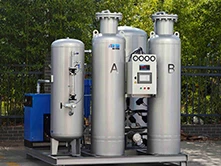



The story of PSA oxygen generator
May 07, 2024
Leave a message
Pressure swing adsorption (PSA) not a new process and, like most good inventions, with the advantage of hindsight the principle appears obvious. As In all adsorption separation processes, the essential requirement 1s an adsor-bent that preferentally adsorbs one component (or one family of related components) from a mxed feed. This selectivity may depend on a diference in adsorption equilibrium or on a diference im sorption rates (kinctic selectivity). In certain cases the difference in rates may be so great that the slower-difusing species IsS In effect totaly excluded from the adsorbent (size-selective sieving), and 1n this situation a very eficient separation can obvlously be achieved.
All adsorption separation processes involve two principal steps:
(1) adsorp-tton, during which the preferentally adsorbed specles are plcked u from the feed;
(2) regeneration or desorption, during which these species are removed from the adsorbent, thus "regenerating" the adsorbent for use In the next cycle. useful products from cither the adsorption or regeneration steps or from both steps. The effuent durng the adsorpton step is purifed rafinate" product from which the preferentially adsorbed sDecies have been removed. The desorbate that Is recovered during the regeneration step contains the more strongly adsorbed speces m concentrated form (relative to the feed) and is sometimes called the"extract" product.
The essentlal feature of a PSA process IS that, during the regeneration step, the preferentally adsorbed species are removed by reducing the total pressure, rather than by raising the temperature or purging with a displacing
The concept of a PSA process.(a)Chinge m cquilibrum loading with prcsure.(h)idcalized sketch showing mtwement ol the adsorheu phse cnceiration profilc for the nore strongly udsorbed spccies in a stmple two-bed PSA process.
agent (although a low-pressure purge step is commonly included in the cycle)The process operates under approximately isothermal conditions so that the useful capacity is the diference in loading between two points,corresponding to the feed and regencration pressures,on the same isotherm[Figure 1.1(a)l.Figure 1.1(b) shows schematically the movement of the concentration profiles during the high-pressure feed and low-pressure regeneration steps.The feed step is normally terminated before the more strongly adsorbed component breaks through the bed,while the regeneration step is generally terminated before the bed is fully desorbed.At cyclic steady state the profle therefore oscillates about a mean postion in the bed

Psa Oxygen Gas Generator

Psa Medical Oxygen Generator

PSA Medical Oxygen Plant
A major advantage of PSA, rclative to other types of adsorption process such as thermal swing,is that thc pressure can be changed much more rapidly than the temperature,thus making it possible to operate a PSA process on a much faster cycle, thereby increasing the throughout per unit of adsorbent bed volume.The major limitation is that PSA processes are restricted to components that are not too strongly adsorbed.If the preferen-tially adsorbed species is too strongly adsorbed,an uneconomically high vacwum is required to effect desorption during the regeneration step.Thus,for very strongly adsorbed components thermai swing is generally the prefered opton since a modest change of temperature produces,in general,a relatively large change in the gas-solid adsorption cauilibrum constant.
PSA proceses are no more complex than most of the more conventonal separation processes,but they are diferent in one essential feature:the PTOCess Operates under transent conditions, whereas most proceses such as absorption,extraction,and distitation operate under steadystate conditions.
As a resull,both the conceptual framework and the design procedures are quite different. This difference can best be explained in mathematical terms.A steady-state process can be described mathematically by an ordinary difierential eauation(or a set of ordinary diferential equations),and to obtain the relationship between the operaing varables and the process performance reauires only the integration of this set of equations.By contrast,a transient process is described by a sct of partial differential equations and this requres a more complex solution procedure.As a result the relationship between the process performance and the operational varl ables is generally less obvious. Procedures or the design and scalcup of PSA unts are for the most part available in the open literature.However,they have not yet been generally accepted as part of the normal chemical engi neering curriculum and,as a result,a certain air of mystery persists.
Desptte therr early inception, it was really only during the that PSA processes gained widespread commercial acceptance.This is llustrated in Figure 1.2,which shows a plot of the annual numbers of publications and U.S.patents relating to PSA processes against the year. The reasons for his unusually long delay between the invention and commercralization of such processes are not entirely clear,but it seems likely that the opposition of entrenched interests in the cryogentc gas industry and the lack of familiarity with the underlying principles among practicing engineers were probably significant factors. During the 1970s interest in alternative separaton Dro-cesses was stmulated by the escalation of energy costs associated with the rising price of crude oil.Although energy costs fell during the ,the impetus to examine alternative processes and to match the technology to the product specifications has continued.